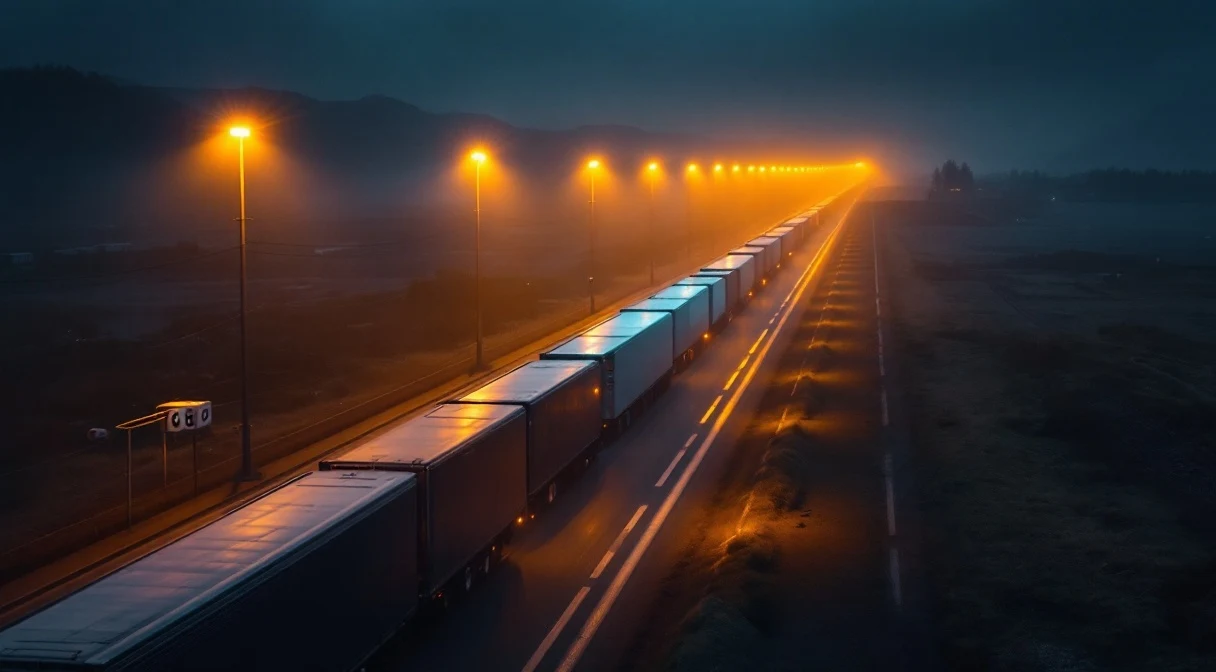
Border wait time is one of the hardest losses to report in a fragmented operation. Because the loss is not a single line item — it scatters across three different budgets.
Three-component cost
Suppose a truck waits 3 hours at Kapıkule. Lognari breaks that down as follows:
- Driver-hour cost — hourly gross + benefits. On the TR–DE corridor it is modelled at €10–€18/hour within the EU/AETR framework. 3 hours × €14 = €42.
- Idle fuel burn — a modern Mercedes-Benz Actros or Volvo FH diesel burns 2–5 L/hour at idle. 3 hours × 3 L × €1.40/L = €12.60.
- Customer-delay impact — missed appointment slot, second-shift loading, detention triggers. Contract-dependent, on average €20–€80.
Total: €75–€135 / truck / border wait.
Cumulative effect at fleet scale
A 50-truck fleet crosses Kapıkule about 600 times per month. 30% of wait hours exceed 3 hours. So:
180 trips × €95 average = €17,100 / month in Kapıkule wait cost alone.
Where this budget comes from is usually unclear because:
- Fuel → “fuel budget”
- Driver wage → “personnel budget”
- Customer delay → disappears as “operational variance” with no trace
What does Lognari do?
It joins three signals on the same trip event:
- GPS geofence in/out → wait time (automatic).
- Hours × driver rate → driver-hour impact (from your HR table).
- OBD idle consumption × fuel price → idle-fuel impact.
The result is a single line: “34 LG 812 · Kapıkule TR-out · 11.05 · 218 min · €83”.
By month-end this becomes a report broken down by trip, vehicle and customer. On the CFO dashboard it materialises as “€17K Kapıkule”.
Economic threshold for an alternate-gate decision
Hamzabeyli is roughly a +40 km detour from Kapıkule. That cost:
- 40 km × 30 L/100 km × €1.40/L = €16.80 extra fuel
- 40 km / 70 km/h = ~34 min extra driving × €14/h = €7.90 extra driver
- Total: ~€25
So the moment Kapıkule wait exceeds €25, switching to Hamzabeyli becomes the financially rational call. Lognari surfaces this as a live decision flag for the trip planner.
This piece uses a typical mid-fleet scenario. Real numbers vary with driver-wage scale, fuel contract, customer agreement and gate distribution.